
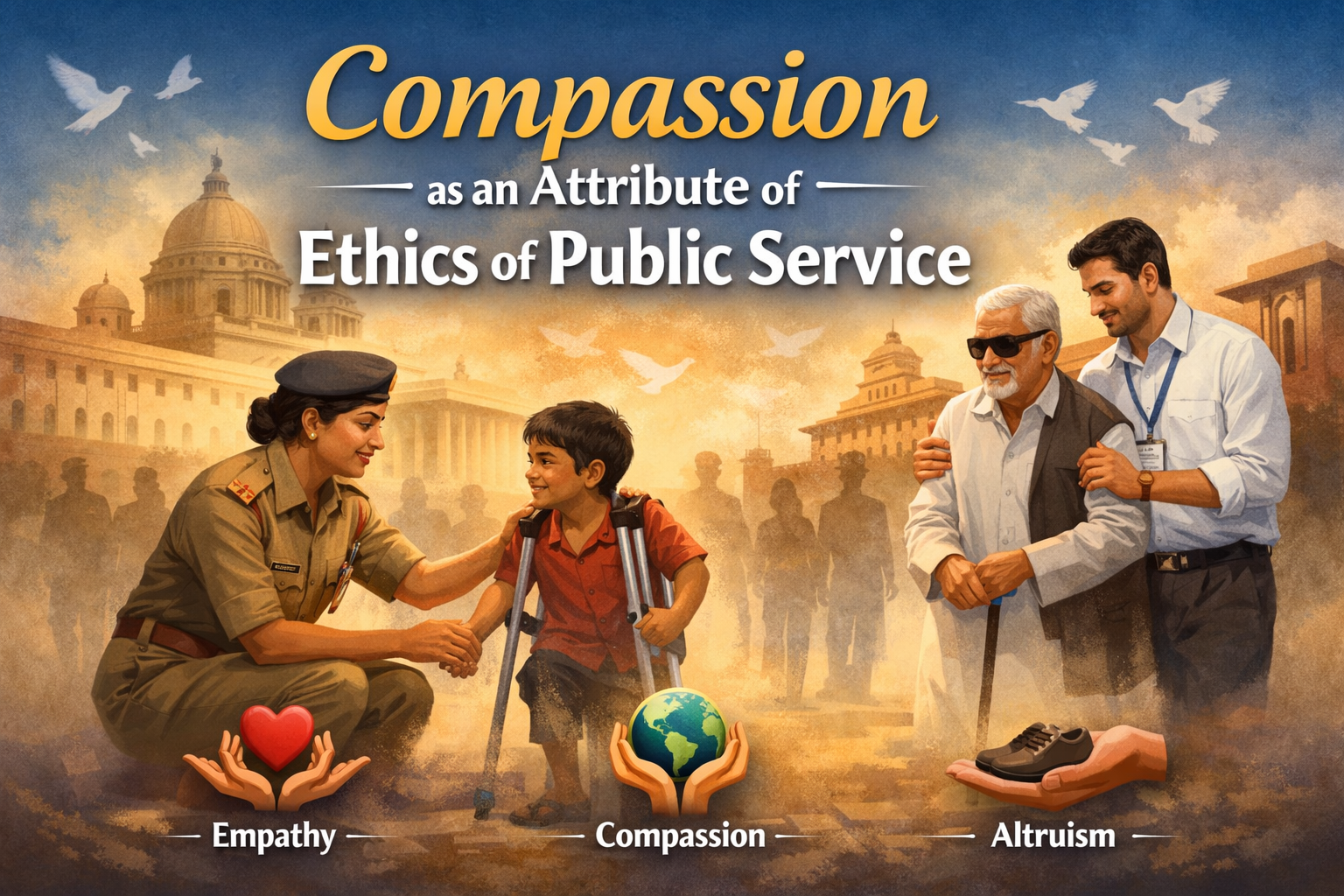
In the Ethics of Public Service, compassion plays a vital yet often underemphasized role. Civil servants frequently encounter human suffering in the course of their duties, but the extent to which they respond with compassion can significantly influence the quality and effectiveness of governance.
During my sessions on the Ethics of Public Service, I often narrate a personal experience that shaped my understanding of compassion in administration. An encounter with more than two hundred polio-stricken children, many struggling to walk on crutches, proved to be a life-changing moment. Witnessing such suffering evoked deep compassion, even in a seasoned bureaucrat like me. While my response to that situation is a separate story, the incident led me to reflect on a larger ethical question.
Do all public officials respond similarly when confronted with human suffering? If not, what explains this difference?
Compassion as a Core Value in Ethical Governance
It gradually became clear to me that public officials in positions of authority can greatly amplify the value of public service if they consciously cultivate compassion in their daily administrative interactions. However, civil servants are not always adept at understanding what citizens are thinking or feeling, even when they attempt to empathize.
Our minds often reinforce pre-existing beliefs. For instance, perceptions of protest violence may vary depending on whether one agrees with the cause. As a result, we do not perceive the same event in the same way. This cognitive bias affects ethical decision-making in public administration.
More often than not, we focus on differences rather than shared human experiences. By asserting “I am different”, civil servants distance themselves from the collective identity of public service. This detachment can generate mistrust and resentment. Recognizing our perceptual limitations is the first step towards ethical self-awareness and compassionate governance.
Understanding Compassion in the Context of Public Service
What Is Compassion in Ethics of Public Service?
There is broad agreement that compassion involves:
-
Recognizing suffering
-
Emotionally resonating with it
-
Being motivated to act to reduce it
In Buddhist philosophy, compassion is not merely an emotional reaction but a reasoned and ethical response rooted in wisdom. It emphasizes selfless intent and responsibility toward alleviating suffering—principles that align closely with ethical public administration.
Compassion, when expressed naturally and sincerely by civil servants, strengthens public trust and reinforces the moral foundations of governance.
Case Study: Compassionate Leadership in Administration
A powerful example of compassion in public service is that of a lady officer who, during a routine field inspection, noticed an elderly man standing silently in a corner. Upon inquiry, she learned that the man was suffering from cataracts in both eyes and had no family support. Without delay, she took him to an eye hospital in her official vehicle, ensured free surgery, and arranged for his safe return to the village.
(Usha Padhi)
Such acts reflect ethical leadership driven by compassion rather than mere procedural compliance.
Compassion vs Empathy vs Altruism in Ethics:
Compassion is often misunderstood and confused with related concepts:
Empathy - Empathy refers to emotionally experiencing another person’s feelings. It is an automatic emotional response, such as feeling sorrow when witnessing someone else’s grief.
Altruism - Altruism involves actions intended to benefit others. However, altruistic acts may not always stem from compassion—for example, donations made solely for tax benefits.
Compassion - Compassion integrates empathy with ethical intent and altruistic action. It involves a genuine desire to alleviate suffering and is central to ethical decision-making in public service.
Research shows that compassion fosters better mental and physical health, strengthens social bonds, and contributes to long-term well-being.
Case Study: Operation Charan Paduka
Another compelling example of compassion in administration comes from Rajasthan. A young district magistrate was deeply moved by the sight of children walking barefoot in extreme heat because their families could not afford footwear. He initiated Operation Charan Paduka, under which more than one lakh pairs of shoes have been distributed so far.
(Jitendra Soni)
This initiative demonstrates how compassion can be institutionalized into sustainable public service programs.
Psychological and Social Impact of Compassion
Compassion enhances emotional well-being and strengthens social cohesion. It broadens perspectives beyond self-interest and acts as a buffer against occupational stress, particularly in demanding administrative roles.
Interestingly, compassion is also contagious. Witnessing acts of kindness triggers emotional elevation and releases oxytocin, often motivating others to act compassionately. This phenomenon explains chain reactions of generosity, such as people paying tolls or coffee bills for strangers, creating a ripple effect of ethical behaviour.
Can Compassion Be Cultivated Through Training?
Although compassion is an evolved human instinct, research indicates that it can be strengthened through structured training. Compassion-based meditation practices, many derived from Buddhist traditions, have shown measurable benefits.
In collaboration with Thupten Jinpa, the personal assistant to the Dalai Lama, Stanford University’s Centre for Compassion and Altruism Research and Education (CCARE) developed the Compassion Cultivation Training (CCT) program. Early research suggests that this program reduces social anxiety and enhances compassion levels among participants.
Further research is required to fully understand how compassion training promotes ethical conduct and altruistic behaviour in public institutions.
Conclusion: Compassion as an Ethical Imperative in Public Service
Compassion deserves formal recognition as a core component of the Ethics of Public Service. Civil servants must introspect on their own experiences of compassion and consciously integrate compassionate approaches into public service delivery.
By doing so, they do not merely adhere to ethical codes—they embody ethical governance in its truest sense.